Rezisténsia · A Badiu community of resistance
The Rabelados
The ones who would not be moved.
Deep in the mountains of Santiago’s interior — the Badiu heartland — a community chose exile and hardship over surrendering the faith and customs of their ancestors. The Rabelados are among the purest expressions of the Badiu spirit of independence.
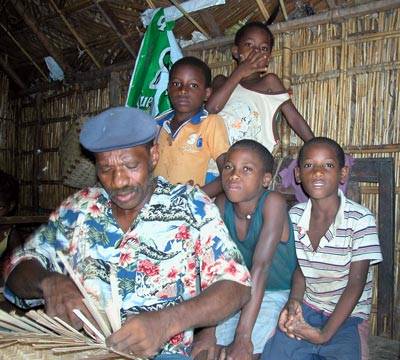
Rabelados today, most at Espinho Branco in São Miguel
the liturgical reforms they rose against
the interior highlands where they took refuge
Ken ki es é · Who they are
A people apart, by choice
The Rabelados are a religious community of the interior of Santiago. They emerged from groups who refused the changes the Catholic Church imposed on worship and religious teaching in the 1940s, and who withdrew from the wider society rather than accept them.
Ridiculed, denounced, and persecuted, they were driven into the least accessible highlands of Tarrafal and Santa Cruz. In that semi-clandestine isolation they preserved their traditions — and their independence from both the Church hierarchy and the colonial state.
Modi ki tudu kumesa · How it began
The reform they would not accept
In the 1940s the Catholic Church sent new priests to Cape Verde to replace local clergy, bringing changes to how Mass was celebrated and how the faith was taught. To many in the interior, these were not small adjustments but a break with the religion their grandmothers had handed down.
Groups of the population refused. They carried on their older observances in secret, and for that they were exiled to other islands and, in some cases, imprisoned. To survive, they closed ranks into tight, self-reliant communities — and the interior kept them.
Bida na interior · Life in the interior
Simplicity as a discipline
The land and the sea
They live chiefly from agriculture, fishing, and craft — the same rhythms of work that have sustained the interior for centuries.
A refusal of modern symbols
Radio and television are set aside. The community keeps a plain, deliberately austere way of life, with a millenarian cast.
The days of worship
Religious observance falls on Saturdays or Sundays. On those days they do not work, walking long distances on foot to places of worship and fasting until mid-afternoon.
Independence, held close
Their distance from Church and state was never only geographic — it is a chosen autonomy, guarded across generations.
Oji · Today
Espinho Branco, and a fading generation
The largest Rabelado community — around two thousand people — lives today at Espinho Branco, in the municipality of São Miguel. Their houses are simple; their traditions, still theirs. But the community is thinning: as the eldest pass, many of the young drift from the old observances. Their long-time leader, Nho Agostinho, died in 2006; Moisés Lopes Pereira followed him.
In recent years there has been some opening to the outside, and study of the community. The painter Misá has worked to make their art and traditions known — Rabelado painters such as Tchetcho have shown work as far afield as the ARCO contemporary-art fair in Madrid.
Pamodi kes ta konta · Why they matter
“The Rabelados remain a symbol of the Cape Verdean spirit of resistance and independence before every power that would command it.”
Their story belongs to the larger Badiu story: the interior of Santiago as a place where African-descended people held their own ground, their own faith, and their own name — on their own terms.
Sources & method
Drawn from Júlio Monteiro, Os rebelados da ilha de Santiago de Cabo Verde (Centro de Estudos de Cabo Verde, 1974); the account by Luís Carvalho in Fragata; and the public record of the community at Espinho Branco. This is an evolving page. Further first-hand material will be added only after a consent-led review process is established.